Log Burner Hearth Cost & Regulations (UK 2026)
UK 2026 log burner hearth cost: £150–£1,500 depending on material and bespoke fabrication. England and Wales publish Part J hearth guidance; Scotland and Northern Ireland use separate national documents, alongside the appliance instructions.
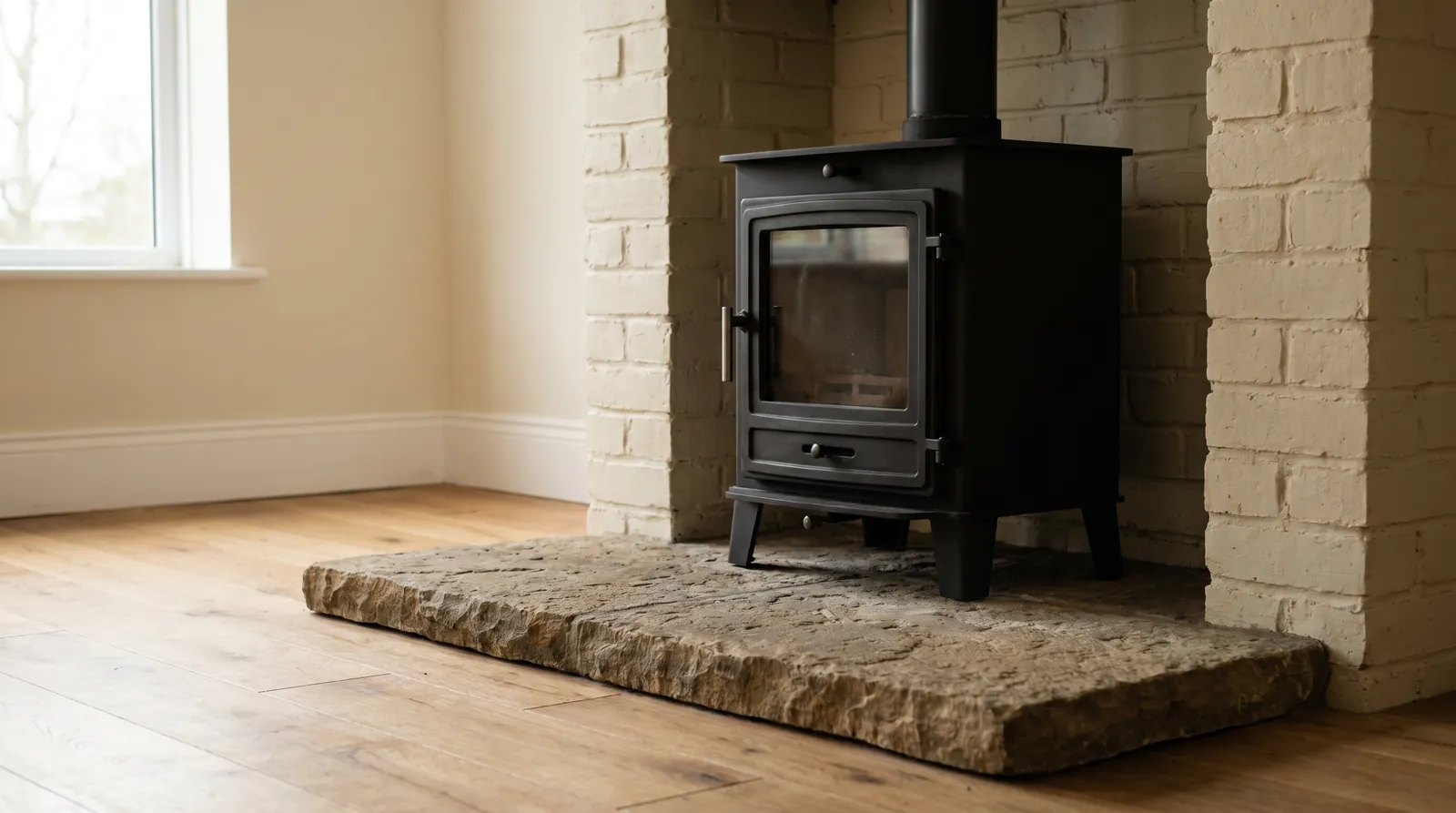
The short answer
Prefab slate or granite hearth: £150–£600. Bespoke stonework: £500–£1,500+. The cost variable that catches most UK first-time buyers is whether you need a constructional or superimposed hearth — see the next section.
Get your full install estimate
The calculator includes hearth costs in the itemised breakdown. Pick your scenario and stove tier for a personalised range.
Open the calculatorConstructional vs superimposed hearths
English and Welsh Approved Document J guidance distinguishes two hearth arrangements, and the difference materially affects cost:
- Superimposed hearth: a thin (12mm minimum) decorative layer placed over the existing floor. Permitted only if the stove is certified to keep the hearth surface below 100°C. Most modern Ecodesign stoves qualify; check the manufacturer’s data plate.
- Constructional hearth: solid masonry or concrete, minimum 250mm thick (or 125mm if you maintain a 50mm ventilated air gap beneath). Required if the stove heats the base above 100°C, or if the existing floor is combustible timber and you can’t safely use a superimposed hearth.
A superimposed slate hearth on a solid concrete floor is the cheapest UK install. A constructional concrete hearth on timber joists with required air gap is the most expensive — often pushing the hearth alone to £600–£1,000.
Minimum hearth dimensions
- Freestanding stove (no fireplace recess): minimum total hearth area 840×840mm
- Front projection: at least 300mm beyond the stove door (to catch falling embers during refuelling)
- Side and rear projection: at least 150mm beyond the stove body
- Stove in fireplace recess: hearth must project at least 500mm from the front of the chimney breast, and extend at least 150mm wider on each side of the recess opening
- Visible boundary: a raised edge of at least 12mm, or a clearly contrasting material — to warn occupants against placing combustible items too close
Hearth materials and prices
| Material | Prefab | Bespoke | Notes |
|---|---|---|---|
| Slate | £150–£200 | £300–£500 | Most popular UK choice. Durable, easy to clean. |
| Granite | £200–£300 | £300–£600 | Heat-resistant, polished finish. Heaviest material. |
| Limestone | £300+ | £500–£800 | Lighter, more porous. Requires sealing. |
| Glass (toughened 12mm) | £200–£400 | £400–£800 | Modern look. Needs absolutely flat sub-floor or it cracks. |
| Brick / Concrete (constructional) | £150–£300 | £300–£600 | Heaviest constructional option. Best for high-temp stoves. |
Add ~£150 labour for basic install, £300–£800 for bespoke stonework or raised hearth construction.
Common UK installer recommendations
- Slabbed granite hearths (cut into sections and rejoined with expansion joints) are recommended over single solid stone slabs on timber subfloors — accommodates thermal movement without cracking
- Avoid standard un-slabbed wall tiles on a timber subfloor — the thermal shock from the stove cracks them quickly
- Vermiculite or fire-board liners in the firebox chamber are separate from the hearth and add £50–£200 for materials
Get free log burner installation quotes
Postcode + scenario + budget. We pass your enquiry to installation businesses serving your area, and they contact you with quotes. Free, no obligation.
Get quotesFrequently asked questions
How much does a log burner hearth cost?
UK 2026: £150–£1,500 depending on material and bespoke fabrication. Prefab slate or granite £150–£600. Bespoke stonework £500–£1,500+. Constructional hearths (required if your stove heats the base above 100°C) £300–£800.
What’s the difference between a constructional and superimposed hearth?
A superimposed hearth is a thin (12mm minimum) decorative layer placed on top of the existing floor — permitted only if the stove is certified to keep the hearth surface below 100°C. A constructional hearth is solid masonry or concrete at least 125mm thick (250mm if directly on combustibles like timber joists), required for any stove that heats the base above 100°C.
What’s the minimum hearth size for a UK log burner?
English and Welsh Approved Document J guidance commonly uses an 840×840mm minimum freestanding hearth area, with projections and thickness determined by appliance design and location. Scotland and Northern Ireland publish separate hearth provisions, so there is no single UK minimum to apply without checking location.
What materials can I use for a hearth?
Any non-combustible material with adequate thickness: slate, granite, limestone, glass (12mm toughened minimum), brick, concrete, ceramic tile over concrete. Glass hearths look modern but require an absolutely flat sub-floor — even small unevenness can cause thermal cracking.
Can the existing floor be the hearth?
Yes, if it’s non-combustible (tiled concrete, stone) and the stove is certified to keep the hearth surface below 100°C. A permanent visible boundary still needs to be established with a contrasting tile, grout line, or metal trim — to warn occupants against placing combustible items too close.